

Why I Love Reading: Freakonomics by Steven Levitt and Stephen Dubner
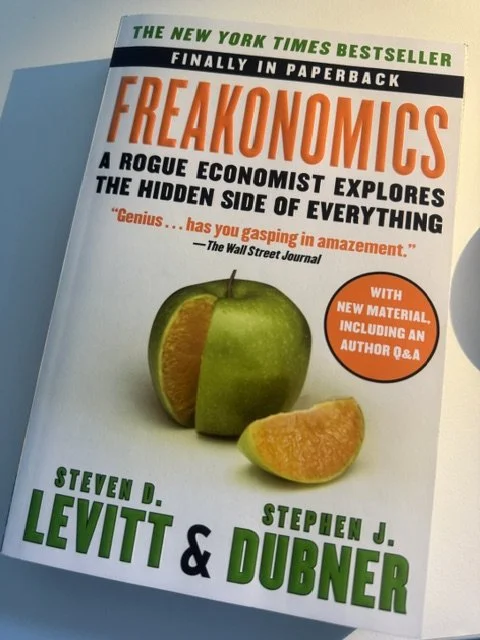
Why this book?
In spite of some of the methods behind Freakonomics facing more recent criticism, I believe there’s value in the book’s central challenge: stop accepting the obvious answer simply because everyone repeats it.
Freakonomics uses economic thinking to question conventional wisdom, uncover hidden incentives, and examine behaviour. It also demonstrates why data interpretation matters.
For organization leaders, that lesson is useful. The first explanation is often the easiest one, not necessarily the right one.
One idea I can’t stop thinking about
Correlation is not causation.
Two things can happen at the same time without one causing the other. That sounds obvious when written down. But we confuse the two constantly.
Sales rise after a campaign, so we credit the campaign. Productivity drops after a policy change, so we blame the policy. A strong employee follows a certain process, so we make everyone copy it.
Maybe those conclusions are right. Maybe they are not.
Before taking a position, changing direction, or fixing the first thing in sight, we need to isolate what caused the result, instead of assuming that something that took place at the same time was the cause. Measure, hypothesize, measure again.
How it shaped the way I lead and communicate
Freakonomics reinforced a leadership habit I value: staying curious when an answer feels too easy (not to be confused with over-thinking). Evidence-based leadership is not about hiding behind numbers. It is about using evidence to ask better questions. Questions like:
What changed?
What else happened at the same time?
Whose behaviour are we trying to understand?
What incentives are shaping that behaviour?
And what evidence would prove our first explanation wrong?
These questions can slow down a hasty reaction and prevent expensive mistakes.
How to apply these lessons
1. Question conventional wisdom
Every organization has rules that nobody remembers choosing.
“We have always done it this way” is not a business case. Neither is calling something a best practice without checking whether it still works in the current situation. Look at the process. Ask what problem it was meant to solve. Then decide whether that problem still exists or if there is a better way to solve it now.
We can do this examination together in a discovery session.
Sometimes the obstacle is not a lack of effort. It is an old assumption that nobody has challenged.
2. Separate correlation from causation
When a metric changes, resist the urge to claim the first available explanation.
Suppose employee turnover increases after a return-to-office policy begins. The timing matters, but it does not prove the policy on its own caused every departure. Compensation, management changes, culture, workload, or outside opportunities may also be involved.
Start with a theory. Then test it against other evidence before you act.
3. Find the hidden incentives
People respond to what gets rewarded, measured, and noticed.
If a sales team is rewarded only for call quantity, conversation quality may suffer. If managers are judged only on speed, careful work and mentorship may disappear. If employees are told to collaborate but praised for individual results, competition will win (remember the crabs in a barrel?).
When behaviour does not match expectations, look at the incentives before blaming the people.
This is the power of reading
“Question conventional wisdom” is a tired phrase. But it’s an important leadership skill. Think of it as flexing your curiosity muscle: Ask why; Challenge assumptions; Do not react too quickly. Curiosity helps you avoid common traps.
It is easy to stay on the known path. We check the boxes, keep moving, and avoid friction. But an easy path is not always the right one. Freakonomics reminded me to stop, look again, and ask what is really driving the result. Curiosity opens up possibilities.
That is what reading often does for me. It challenges what I believe, how I work, and offers opportunities to do better.
Sometimes a book gives us a new idea. Other times, it forces us to face an old truth we have stopped practicing.
This weekend, crack open a book, even if you read only one chapter. Let it interrupt your thinking. I am usually better for it. You might be, too.
Next step: What book has changed the way you lead, communicate, or make decisions? Reply and tell me. I may add it to my reading list.
Want to talk through a problem in your organization? Book a free discovery call with me. It is a quick, no-pressure way to get a fresh perspective and question what may really be causing it.