

Implementation Fails for Three Reasons. None of Them Is Resistance.
A CEO asked their team, mid-meeting, to define implementation. That question changed the way I think about translating strategy out of the boardroom and into the workplace.
They had been talking about implementation for an hour, but the CEO was seeing disconnects. Each person meant something different. Some were talking about project plans. Some were talking about behavioural change. Some were talking about adoption metrics. One was talking about culture. None were wrong.
Project plans, behavioural change, adoption metrics, and culture aren't competing definitions of implementation - they're four parts of the same thing, and all must be named and owned by the leadership team, together, or the strategy stalls.
A plan without behaviour change is paperwork. Behaviour change without an adoption metric is a guess. Culture without a plan is a slogan.
Leadership's job isn't to pick one. It's to define all four out loud so the organization is translating one strategy instead of multiple.
Implementation is not the phase that comes after strategy. It is what strategy looks like when it is being lived inside the organization — by people who did not write it, who interpret it through the work they already do, and who are watching to see whether leadership behaves like the strategy is real or flavour-of-the-month.
When implementation fails, it is usually because the strategy never made the trip from the executive team to the work itself, or because the leadership team defined only one part and assumed the rest would follow.
I see three patterns in organizations where this is happening right now.
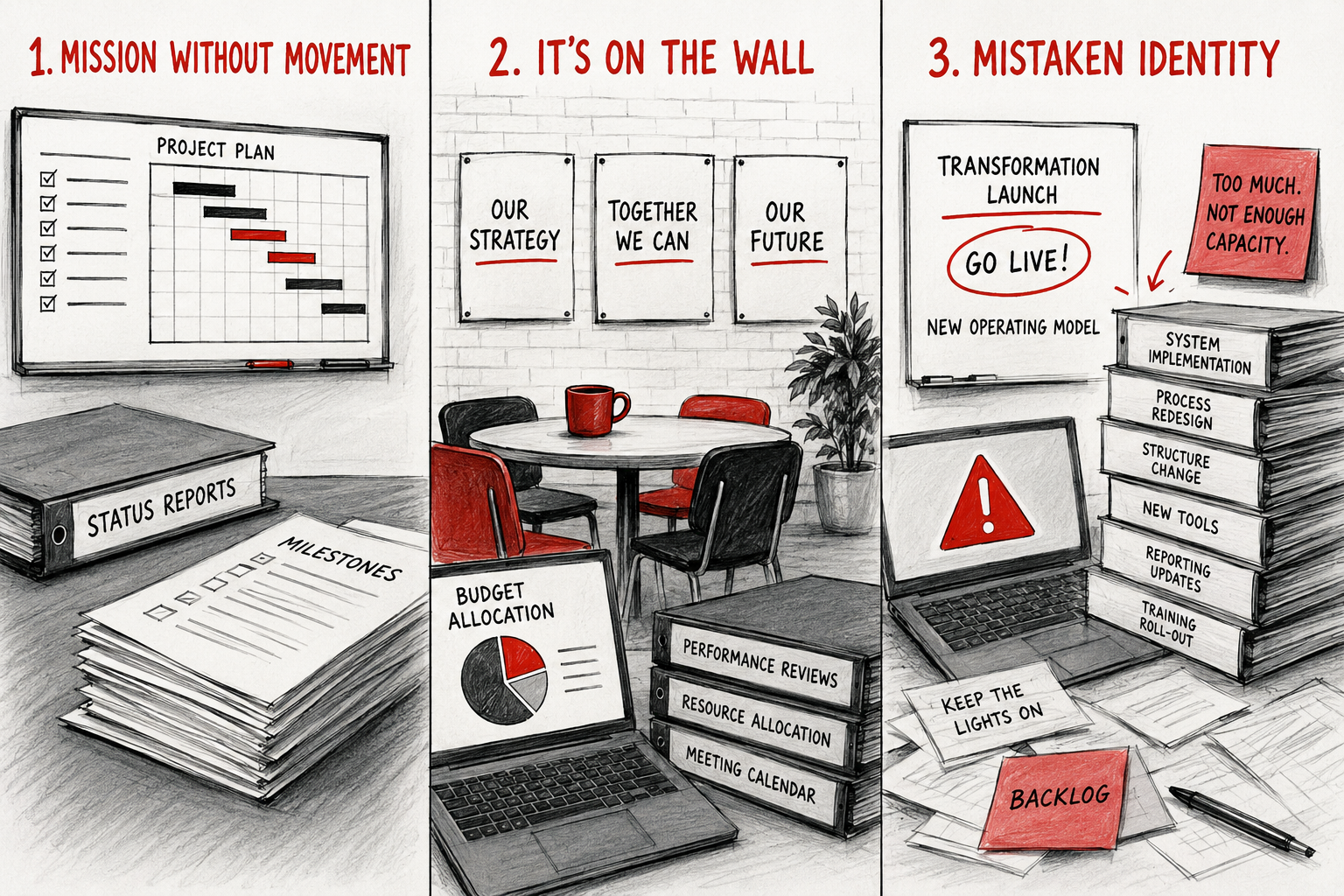
Mission without Movement: the strategy got handed off to a project management office and stopped being a leadership conversation. The PMO does its job — Gantt charts, milestones, status reports. But strategy needs to be debated, refined, and reinforced by leaders week after week. If it is handed over, the conversation stops. It becomes a workplan. The workplan moves. The strategy does not.
It's On the Wall: the strategy was translated into messages but never into operating priorities. Posters in the lunchroom. Emails to all-staff. A leadership video. Meanwhile, the budget process, the performance review process, the resource allocation process, and the meeting calendar all still reward previous outdated priorities. People watch what gets funded and rewarded. That is the strategy they are living, regardless of what is on the wall.
Mistaken Identity: the strategy assumed the organization could absorb more change than it had capacity for. The transformation team launched on schedule. The system went live. The new operating model was announced. And the people who were already running too many concurrent initiatives could not stop doing the old work fast enough to make room for the new. Adoption stalls. The leadership team blames change resistance. It is not resistance. It is capacity.
Look closely at all three and the same thing is missing each time: a leadership team that defined one part of implementation and stopped there. A project plan with no room left for a conversation about behaviour. A message with no accompanying shift in what gets funded. A launch date with no accounting for what capacity the organization had left. Three different patterns, one shared cause. Nobody in the room finished naming the parts before moving on.
That is usually the moment I get called in to help a leadership team see what got skipped, and where the adoption data is already telling them so. If that sounds familiar and your transformation is far enough along that the numbers should be moving by now, stay tuned. I have something coming soon built for this gap. It’s a diagnostic that looks at where adoption is breaking down, what the friction is, and what the next intervention could be.
Are you interested in it? Sign up today for my newsletter to make sure you are part of the launch!
In the meantime, the question worth asking your leadership team this week is the one the CEO asked theirs: when we use the word implementation, what do we mean?
The answer often tells you why your strategy is not moving.